In today's digital-first world, customers want to explore a business before deciding to visit, book, or make a purchase. Heltog Technologies helps businesses strengthen their digital presence through innovative solutions, including 360 photography and virtual tours that allow potential customers to explore real spaces from anywhere. Whether you manage a hotel, real estate property, showroom, restaurant, or commercial space, an immersive visual experience can help you present your business in a more engaging and transparent way.
Traditional photographs are useful for showcasing a property or business, but they only capture selected angles. With 360 photography and virtual tours, visitors can look around a space, explore its surroundings, and get a better understanding of what it offers without being physically present.
As online customer expectations continue to evolve, interactive visual content is becoming a valuable way for businesses to communicate their offerings and create more meaningful digital experiences.
What Is 360 Photography and Virtual Tours?
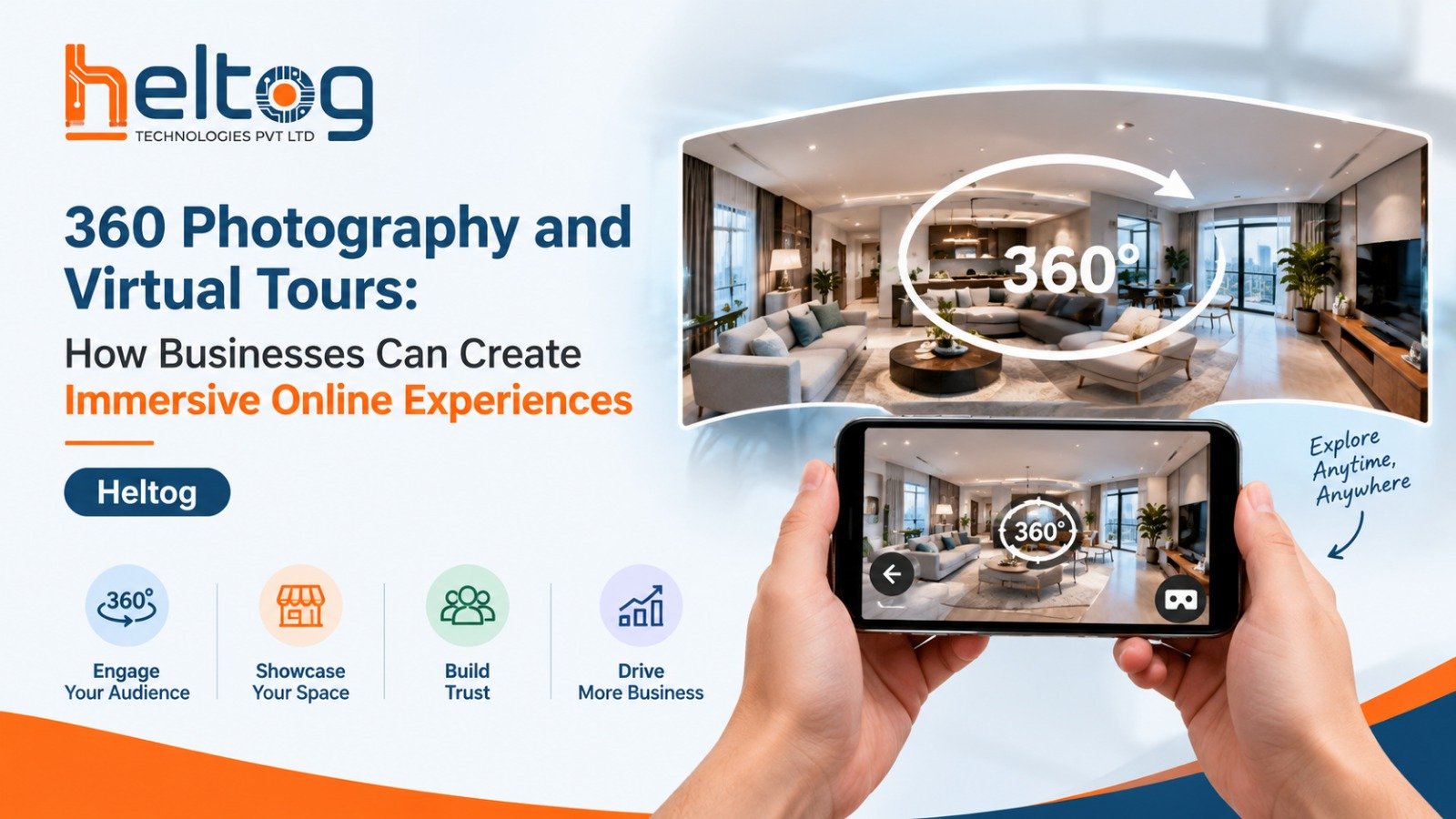
360 photography is a technique that captures a complete view of a location, allowing viewers to look around in different directions. Instead of seeing only one fixed angle, users can explore the environment by moving their screen, dragging their cursor, or interacting with the image.
A virtual tour takes this concept further by connecting multiple panoramic images or interactive scenes to create a navigable digital representation of a physical space.
For example, a hotel virtual tour might allow a potential guest to explore the reception area, walk through a suite, view the restaurant, and examine other facilities before making a reservation.
Similarly, a real estate virtual tour can help buyers understand the layout of a property before scheduling an in-person visit.
The goal is simple: give online visitors a clearer, more realistic impression of a place and make it easier for them to decide whether it meets their needs.
How Does 360 Photography Work?
Creating a professional 360-degree experience involves more than taking panoramic photographs. The process combines photography, image processing, interactive software, and thoughtful presentation.
Here is how it typically works.
1. Planning the Location
The first step is understanding the business, its audience, and the areas that should be highlighted. A hotel may want to showcase its rooms and amenities, while a retail store may focus on its product displays and interior layout.
Planning helps ensure that the final tour communicates the right information.
2. Capturing 360-Degree Images
Specialised cameras or compatible photography equipment capture a panoramic view of the space. Depending on the project, several images may be required to represent different rooms, sections, or viewing points.
Lighting, composition, image clarity, and camera positioning all influence the final result.
3. Processing and Stitching Images
When multiple images are captured, they may need to be combined into a seamless panoramic view. Editing and processing help create a consistent visual experience with fewer distracting transitions.
4. Building the Interactive Tour
The panoramic images are connected through virtual tour software. Navigation points, room transitions, labels, and other interactive elements can help users move between different areas.
5. Publishing and Sharing
Once completed, the virtual tour can be embedded on a website or shared through suitable online platforms. Businesses can also use it in digital marketing campaigns and other customer communication channels.
The result is an interactive experience that helps potential customers explore a location at their own convenience.
Why 360 Photography and Virtual Tours Matter for Businesses
A well-designed virtual tour can do more than make a website look attractive. It can help businesses communicate their value, answer common customer questions, and make their online presence more informative.
1. Create a Strong First Impression
Customers often form an initial opinion about a business through its online presence. High-quality visuals can help communicate professionalism and give visitors a better understanding of the environment.
For example, a restaurant can use a virtual tour to showcase its seating arrangements, ambience, and interior design. A hotel can highlight its room interiors, reception, and available facilities.
When customers can explore these details before visiting, they have more information to guide their decisions.
2. Build Trust Through Transparency
Customers may hesitate to book a hotel, schedule a property visit, or visit an unfamiliar business if they cannot clearly understand what to expect.
A virtual tour offers a more comprehensive view than a small selection of photographs. It helps visitors assess the space for themselves and develop more realistic expectations.
Although a virtual tour cannot replace every aspect of an in-person visit, it can make the initial evaluation process easier and more transparent.
3. Improve Customer Engagement
Interactive content gives users an active role in exploring a business. Instead of simply scrolling through photographs, they can move between viewing points and examine areas that interest them.
This can make the experience more engaging, particularly when the tour is intuitive, mobile-friendly, and relevant to the audience.
The actual impact depends on the quality of the experience, how it is presented, and whether it meets visitors' needs.
4. Support Better-Informed Decisions
Customers frequently have practical questions before making a booking or purchase.
They may want to know whether a hotel room looks spacious, whether a showroom has the right layout, or whether a commercial property suits their business requirements.
A virtual tour helps answer many of these visual questions before direct contact takes place. This can make enquiries more informed and help sales teams focus on customers whose requirements match the offering.
5. Strengthen Your Digital Marketing Strategy
Visual content can complement other digital marketing activities, including search engine optimisation, social media marketing, paid advertising, and website development.
For example, a real estate company can share a virtual tour through a property listing, while a hotel can incorporate it into a dedicated accommodation page.
Businesses looking to strengthen their broader digital presence can also explore Heltog's digital marketing services to understand how different online channels can work together.
Industries That Can Benefit from 360 Photography and Virtual Tours
Virtual tours are useful for a wide range of businesses, especially those where the physical environment influences customer decisions.
Real Estate and Property Developers
Real estate is one of the most practical applications of virtual tours. Buyers and tenants can explore the layout of apartments, villas, offices, and commercial properties before arranging a physical visit.
Property developers can also use tours to showcase completed projects, model apartments, and selected amenities.
Key benefit: Help prospective buyers and tenants evaluate properties more conveniently.
Hotels and Hospitality Businesses
Hotels, resorts, guesthouses, and homestays depend heavily on customer confidence when people book accommodation online.
A virtual tour can showcase rooms, lobbies, dining areas, conference facilities, and recreational spaces. This helps guests understand the property before confirming a reservation.
Key benefit: Give prospective guests a clearer picture of the accommodation experience.
Retail Stores and Showrooms
Customers may want to understand a store's layout, discover its product categories, or assess the shopping environment before visiting.
Furniture stores, automobile showrooms, home décor outlets, and lifestyle retailers can use 360 photography to make their online presence more interactive.
Key benefit: Encourage customers to explore the store and plan a visit.
Restaurants and Cafés
Food is important, but the dining environment also influences where people choose to eat.
Restaurants can showcase their interiors, seating arrangements, private dining spaces, and overall ambience through a virtual tour.
Key benefit: Help customers understand the atmosphere before making a reservation or visiting.
Educational Institutions
Schools, colleges, universities, and training centres can provide virtual access to classrooms, libraries, laboratories, auditoriums, and campus facilities.
This can be especially useful for parents, prospective students, and applicants who cannot immediately visit the campus.
Key benefit: Make campus information more accessible to prospective students and families.
Healthcare Facilities
Hospitals, clinics, diagnostic centres, and wellness facilities can use virtual tours to introduce their reception areas, waiting rooms, and general facilities.
The presentation should respect patient privacy and avoid displaying confidential information.
Key benefit: Familiarise visitors with the environment before an appointment.
Offices and Commercial Spaces
Businesses offering office rentals, coworking spaces, or commercial properties can use virtual tours to show workstations, meeting rooms, common areas, and other facilities.
Key benefit: Help prospective tenants and clients assess whether the space meets their needs.
How Virtual Tours Can Support Your Online Visibility
A virtual tour is primarily a visual and interactive marketing asset. Its contribution to search visibility depends on how it is implemented and promoted.
Simply adding a 360-degree image does not guarantee higher Google rankings. However, a well-integrated tour can support a stronger online experience.
Improve the User Experience on Your Website
A virtual tour can make important service or property pages more useful by helping visitors understand the business visually.
The tour should be easy to navigate, load efficiently, and work smoothly on mobile devices. It should also be accompanied by descriptive text that explains the business, its offerings, and the purpose of the tour.
Support Local Business Discovery
For businesses serving a specific city or neighbourhood, visual content can complement local search optimisation.
Accurate business information, relevant service pages, customer reviews, and a properly maintained Google Business Profile remain important parts of a local SEO strategy.
Where supported and appropriate, businesses can also explore options for presenting virtual imagery through eligible Google platforms and listings.
Learn more about Heltog's SEO services to understand how local search visibility can fit into a wider digital strategy.
Create More Useful Marketing Content
A completed virtual tour can become a reusable marketing asset. Businesses may link to it from relevant website pages, include it in social media posts, or use it in email campaigns and sales presentations.
For example, a property business could share a tour with prospective buyers before arranging a site visit. A hotel could use it to help guests compare room categories.
The key is to place the experience where it answers a genuine customer question.
360 Photography vs Traditional Photography: What's the Difference?
Both formats have a role in digital marketing. The right choice depends on the business objective.
Feature
Traditional Photography
360 Photography and Virtual Tours
Viewing experience
Fixed perspective
Interactive panoramic view
User control
Limited to the selected image
Users can look around the scene
Space representation
Highlights selected angles
Provides a broader view of the environment
Best suited for
Products, portraits, campaigns, and details
Properties, rooms, showrooms, and physical spaces
Customer exploration
Viewers see what the photographer selected
Viewers can explore different directions
Website integration
Images can be placed across pages
Tours can be embedded where supported
Traditional photography remains valuable for close-up details, promotional campaigns, and carefully composed brand imagery. Virtual tours are more useful when customers need to understand the layout and overall feel of a physical location.
For many businesses, combining both formats provides the most complete visual presentation.
Best Practices for Creating an Effective Virtual Tour
A virtual tour should be designed around the customer's needs rather than created simply because the technology is available.
Keep these practical considerations in mind.
1. Choose the right areas to showcase. Focus on spaces that help customers make decisions. A hotel should prioritise important guest areas, while a property tour should make the layout easy to understand.
2. Prioritise image quality. Clear images, balanced lighting, and consistent exposure make the experience more professional.
3. Make navigation intuitive. Use logical transitions and clearly positioned navigation points so visitors can explore without confusion.
4. Optimise for mobile devices. Many customers browse on smartphones. Test the tour across different screen sizes and ensure that controls are easy to use.
5. Consider website performance. Large image files and embedded interactive tools can affect loading speed. Optimise assets and use suitable implementation methods to maintain a smooth experience.
6. Add useful context. Labels, short descriptions, and clear room names can help visitors understand what they are seeing.
7. Keep the experience accurate. Update the tour when significant changes occur to the property, facilities, or layout. Avoid presenting outdated images as a representation of current conditions.
8. Include a clear next step. After exploring the space, users should know how to book a visit, request information, make an enquiry, or contact the business.
How to Choose the Right 360 Photography and Virtual Tour Service
Selecting a suitable provider is an important part of creating an effective virtual experience.
Before making a decision, consider the following factors:
Portfolio and experience: Review examples of previous tours, image quality, and the provider's ability to present different types of spaces.
Project requirements: Discuss the size of the location, the number of rooms or viewing points, and any special presentation needs.
Interactive features: Ask whether the tour can include navigation points, labels, or other features relevant to your business.
Website compatibility: Confirm how the tour will be embedded and whether it will work well across mobile and desktop devices.
Delivery and support: Understand the expected timeline, revision process, hosting arrangements, and options for updating the tour.
Marketing integration: Consider how the finished tour can be used across your website, social media, listings, and other customer touchpoints.
The best solution is not necessarily the one with the most features. It is the one that presents your space effectively, supports your business goals, and gives customers a smooth experience.
Frequently Asked Questions About 360 Photography and Virtual Tours
1. What is the main purpose of a 360-degree virtual tour?
A 360-degree virtual tour allows people to explore a physical space online from different viewing angles. It helps businesses present their locations more interactively and enables potential customers to understand the environment before visiting.
2. Which businesses should invest in virtual tours?
Real estate companies, hotels, restaurants, retail stores, educational institutions, healthcare facilities, offices, and commercial property businesses can all benefit from virtual tours when the physical environment influences customer decisions.
3. Can I add a virtual tour to my website?
Yes. Depending on the platform and tour format, a virtual tour can often be embedded into a suitable website page or shared through a link. The implementation should be tested for mobile compatibility, loading performance, and usability.
4. Do virtual tours help with SEO?
Virtual tours can support the overall website experience and complement local marketing activities. However, a tour alone does not guarantee higher search rankings. Relevant text, technical SEO, page performance, accurate business information, and useful content remain important.
5. Is 360 photography better than traditional photography?
Neither format is universally better. Traditional photographs are ideal for highlighting specific details and creating visual campaigns, while 360 photography is particularly useful for exploring physical spaces. Using both can help businesses communicate more effectively.
6. What should I consider before creating a virtual tour?
Consider your target audience, the areas you want to showcase, image quality, navigation, mobile compatibility, website performance, budget, and how the tour will support customer enquiries or bookings.
Conclusion: Give Customers a Better Way to Explore Your Business
Customers increasingly expect businesses to provide clear, convenient, and engaging online experiences. 360 photography and virtual tours help meet that expectation by allowing people to explore physical spaces without the limitations of traditional photographs.
From real estate and hospitality to retail, education, healthcare, and commercial properties, virtual tours can help businesses present their spaces more transparently, answer common customer questions, and support better-informed decisions.
The real value comes from combining high-quality visuals with an easy-to-use experience and a clear business objective. When implemented thoughtfully, a virtual tour can become a useful part of your website and digital marketing strategy.
Take Your Business Experience Beyond Traditional Photography with Heltog Technologies
Ready to help customers explore your business from anywhere? Heltog Technologies offers 360 photography and virtual tour solutions designed to help businesses present their spaces through engaging digital experiences.
Whether you want to showcase a property, highlight your hotel facilities, introduce a showroom, or create a more interactive online presence, the right visual strategy can help you connect with potential customers before they arrive.
Explore our 360 Photography and Virtual Tours service and discover how your business can make its spaces more accessible online.
Contact Heltog Technologies today to discuss your requirements and explore a virtual tour solution tailored to your business goals.
Call: +91 99997 34593
Email: info@heltog.com
Website: https://heltog.com/contact
Let your customers explore your space, experience your brand, and take the next step with confidence.
Found this article helpful? Share it!
H
Written by
Heltog Team
Digital marketing and technology expert at Heltog Technologies. Helping businesses grow with smart digital solutions.

Leave a Comment
Your email address will not be published. Required fields are marked *