Digital advertising has always followed the way people search for information. First came search engines, then social media platforms, and now conversational AI is becoming an increasingly important part of the customer journey.
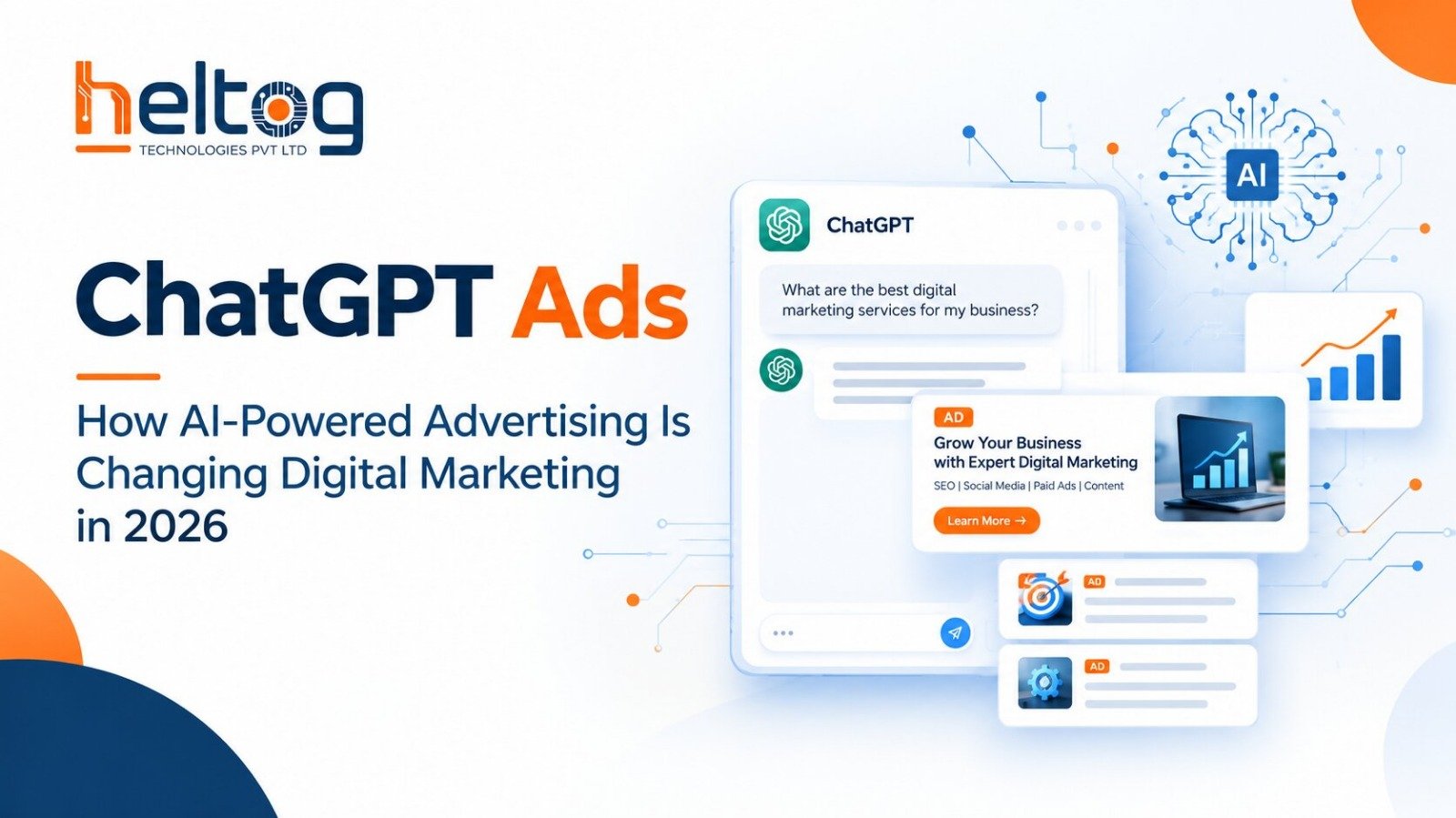
One of the biggest developments in this space is ChatGPT Ads.
Instead of simply typing a few keywords into a search box, users can now have detailed conversations with AI while researching products, comparing services, solving problems, and deciding what to buy. This creates a new advertising environment where context, intent, relevance, and usefulness can matter as much as traditional keyword targeting.
OpenAI has been expanding its ChatGPT advertising platform during 2026, including making Ads Manager available across India, Europe, the Middle East, and North Africa.
For businesses and digital marketers, this raises an important question:
What are ChatGPT Ads, and how can businesses prepare for advertising in an AI-first search environment?
Let's explore it.
What Are ChatGPT Ads?
ChatGPT Ads are advertisements designed to appear within the ChatGPT experience while users explore topics, compare options, and make decisions.
Unlike traditional search advertising, where an advertiser often targets specific keywords, ChatGPT advertising is designed around a more conversational environment.
OpenAI explains that its advertising system can consider signals such as the context and intent of the current conversation, the ad's landing page, title, copy, and other relevance signals.
In simple terms, ChatGPT Ads aim to connect businesses with people at moments when they are actively exploring a need or making a decision.
For example, imagine someone asks:
“What are the best accounting software options for a small business?”
Or:
“I need a digital marketing agency to improve my local SEO.”
These conversations reveal considerably more context than a short search query.
That context creates new opportunities for advertisers.
How Do ChatGPT Ads Work?
The basic idea is relatively straightforward.
Advertisers create campaigns containing elements such as:
Ad titles
Descriptions
Landing pages
Images or creative assets
Campaign objectives
Budget and bidding settings
Relevant context hints
ChatGPT's advertising system then determines where eligible ads may be relevant.
OpenAI says ads remain clearly separated from ChatGPT's answers and are labeled as advertising. The advertising system is designed so that ads do not influence the answers generated by ChatGPT.
This distinction is important because users should be able to understand the difference between AI-generated information and paid advertising.
Why ChatGPT Ads Are Different From Traditional Search Ads
Traditional search advertising generally revolves around keywords and search queries.
For example:
“digital marketing agency Delhi”
A search ad may be triggered because the advertiser is targeting that keyword.
Conversational AI works differently.
A user may explain an entire situation:
“I own a local business and my website gets traffic, but I am not receiving enough enquiries. What should I improve?”
This is not simply a keyword.
It contains information about:
The user's business
Their problem
Their intent
Their potential solution
Their stage in the buying journey
This is one of the biggest differences between traditional search advertising and conversational advertising.
Search advertising often starts with a query.
Conversational advertising can start with a problem.
That shift could have major implications for digital marketing strategies.
Why ChatGPT Ads Matter for Businesses
The biggest opportunity is intent-rich discovery.
People use ChatGPT for much more than finding a website. They use it to research ideas, compare products, understand services, plan projects, and make decisions.
OpenAI positions ChatGPT Ads around these decision-making moments.
For businesses, this means advertising can potentially become part of the consideration process rather than simply competing for a click from a search results page.
Consider a customer who wants to renovate a bathroom.
Their journey could involve questions such as:
What does a bathroom renovation cost?
What materials should I choose?
How long does renovation take?
What design works for a small bathroom?
Which renovation company should I contact?
A business that can provide a useful, relevant solution at the right stage of that journey has an opportunity to influence the customer's consideration.
ChatGPT Ads and User Intent
Understanding user intent will become increasingly important in AI advertising.
A traditional keyword might tell you what someone searched for.
A conversation can tell you why they are searching.
For example:
Low-context query:
“SEO agency”
High-context conversation:
“I run a local service business and want to increase enquiries from Google without spending heavily on ads. What SEO strategy should I use?”
The second example contains much more information.
For advertisers, this creates an opportunity to develop campaigns around real customer problems rather than simply creating lists of keywords.
What Makes a Good ChatGPT Ad?
OpenAI's current guidance emphasizes clear, specific, benefit-focused advertising. Advertisers are encouraged to create multiple useful variations rather than repeatedly using the same message.
A strong ChatGPT ad should answer three basic questions quickly:
What do you offer?
Who is it for?
Why should the user care?
For example, instead of:
“We Are the Best Digital Marketing Company!”
A more useful approach could be:
“Grow Your Local Search Visibility”
with supporting copy explaining the service, target customer, and practical benefit.
The second version communicates value instead of relying on generic promotional language.
ChatGPT Ads vs Google Ads
ChatGPT Ads and Google Ads should not necessarily be viewed as competitors where one completely replaces the other.
They serve different environments.
Google Ads
ChatGPT Ads
Primarily search-driven
Conversation-driven
Strong keyword orientation
Strong contextual relevance
Search query focused
User intent and conversation context
SERP-based experience
Conversational experience
Search results and websites
AI-assisted decision journey
Google remains extremely important for businesses that want to capture direct search demand.
ChatGPT Ads introduce another opportunity: reaching users while they are researching, comparing, and deciding.
For many businesses, the future strategy may involve using both rather than choosing only one.
ChatGPT Ads and SEO: Are They Connected?
Yes, although paid advertising and organic visibility remain different disciplines.
A strong website still matters because the landing page is an important part of an advertising campaign.
OpenAI's advertising guidance emphasizes accurate representation of the offering and landing-page alignment.
This means businesses should continue investing in:
Helpful website content
Strong technical SEO
Fast-loading pages
Clear service information
Good user experience
Internal linking
Structured information
Strong landing pages
Trust signals
Original expertise
This is where SEO, AEO, GEO, and paid AI advertising can begin working together.
ChatGPT Ads and AEO
AEO stands for Answer Engine Optimization.
The goal is to make content easier for answer-focused systems to understand and use.
For businesses, this means answering real customer questions clearly.
Instead of creating content only around:
“digital marketing agency”
a business could also answer questions such as:
What does a digital marketing agency do?
How much does SEO cost?
How long does SEO take?
Is local SEO useful for small businesses?
How can a company improve visibility in AI search?
This approach creates useful content that can support both users and modern search experiences.
ChatGPT Ads and GEO
GEO, or Generative Engine Optimization, focuses on improving a brand's visibility across generative AI search environments.
As customers increasingly ask AI systems for recommendations, businesses need to think beyond traditional rankings.
That means building a strong digital footprint through:
High-quality website content
Authoritative information
Brand mentions
Relevant third-party references
Consistent business information
Helpful educational content
Strong topical expertise
The goal is not simply to “rank” somewhere.
The goal is to become a credible source that AI systems can understand and confidently associate with a topic or service.
How Businesses Can Prepare for ChatGPT Ads
Businesses do not need to completely rebuild their digital marketing strategy overnight.
Instead, they should strengthen the fundamentals.
1. Build Strong Landing Pages
Your advertising campaign can bring someone to your website, but the landing page needs to deliver on the promise made by the ad.
Make sure the page clearly explains:
What you offer
Who you help
Your key benefits
Your process
Why customers should trust you
How to contact you
2. Understand Customer Questions
Start collecting the questions your customers ask before making a purchase.
These questions can become:
Blog topics
FAQ sections
Landing page content
Ad messaging
Social media content
AEO content
3. Create Multiple Ad Variations
AI advertising is not necessarily about finding one perfect advertisement.
OpenAI recommends creating diverse variations so the system has more opportunities to identify relevant messages.
For example, a business could test different angles around:
Price
Convenience
Expertise
Speed
Quality
Location
Specific customer problems
4. Make Your Website AI-Friendly
Clear website architecture helps both users and machines understand your business.
Use:
Descriptive headings
Logical page structures
Clear service pages
Helpful FAQs
Internal links
Structured data where appropriate
Accurate business information
5. Track Performance
Advertising decisions should be based on data rather than assumptions.
ChatGPT Ads reporting can include metrics such as impressions, clicks, spend, CTR, average CPC, average CPM, and conversions.
Businesses should monitor which messages and campaigns are actually generating useful traffic and conversions.
What Are the Benefits of ChatGPT Ads?
ChatGPT Ads can offer several potential advantages.
Contextual Relevance
Ads can be aligned with conversational context rather than relying only on a short keyword.
High-Intent Moments
Users may encounter advertising while researching products, comparing services, or making decisions.
More Natural Discovery
Advertising can become part of a conversational discovery experience instead of appearing only in a traditional results page.
Flexible Campaign Messaging
Businesses can test different messages and value propositions for different situations.
New Customer Touchpoints
ChatGPT adds another potential channel for brands looking to reach customers beyond traditional search and social platforms.
What Are the Challenges?
Like every emerging advertising channel, ChatGPT Ads also come with challenges.
The biggest challenge is that conversational advertising is still relatively new.
Businesses will need to learn:
Which messages perform best
Which audiences respond
How conversational intent affects performance
Which landing pages convert
How to measure assisted conversions
How AI advertising fits into their existing marketing mix
There is also a need for responsible advertising.
OpenAI states that ads are designed to remain separate from ChatGPT's answers, and its policies place restrictions around sensitive and unsuitable contexts.
The Future of AI Advertising
The larger trend is bigger than ChatGPT Ads.
Digital advertising is moving toward an environment where AI understands intent, context, and the customer's journey.
Instead of asking:
“Which keyword should I target?”
marketers may increasingly ask:
“Which customer problem can my business solve, and at what moment is the customer most likely to need that solution?”
That is a much broader way of thinking about advertising.
Search engines, social platforms, AI assistants, recommendation systems, and conversational interfaces are gradually becoming interconnected parts of the digital customer journey.
For marketers, this means the fundamentals remain important—but the way those fundamentals are applied is changing.
Frequently Asked Questions About ChatGPT Ads
What are ChatGPT Ads?
ChatGPT Ads are paid advertisements displayed within the ChatGPT experience. They are designed to help businesses reach users while they explore options, compare choices, and make decisions.
How are ChatGPT Ads different from Google Ads?
Google Ads are primarily associated with search queries and keyword targeting, while ChatGPT Ads operate within a conversational environment where context and intent can play an important role in ad relevance.
Can businesses advertise on ChatGPT?
Yes. OpenAI provides an Ads Manager for businesses to create and manage ChatGPT advertising campaigns, with availability expanding across markets.
Do ChatGPT Ads influence ChatGPT's answers?
According to OpenAI, ads are separate from ChatGPT's answers and do not influence the answers generated by the model.
Should businesses still invest in SEO if they use ChatGPT Ads?
Absolutely. Paid advertising and organic search serve different purposes. Strong SEO, helpful content, technical optimization, and high-quality landing pages can support a broader digital visibility strategy.
How can businesses prepare for AI-powered advertising?
Start with strong fundamentals: understand customer intent, create useful content, improve website quality, build clear landing pages, maintain accurate business information, and measure campaign performance carefully.
Final Thoughts
ChatGPT Ads represent an important development in the evolution of digital advertising.
The biggest change is not simply that advertisements are appearing inside an AI platform. The bigger change is the environment in which those advertisements can appear.
People are using AI to ask questions, explore solutions, compare alternatives, and make decisions. This gives businesses a new opportunity to reach potential customers during highly contextual moments.
However, success will not come from simply copying traditional advertising strategies into an AI platform.
Businesses need to focus on relevance, usefulness, clear messaging, strong landing pages, customer intent, and trustworthy digital content.
For companies preparing for the next generation of search, combining SEO, AEO, GEO, content strategy, and emerging AI advertising channels can create a much stronger digital presence.
As AI continues to reshape how people discover information and make purchasing decisions, businesses that adapt early will be better positioned to remain visible in the changing search landscape.
Heltog Technologies helps businesses build stronger digital visibility through modern SEO, digital marketing, websites, and technology solutions designed for an increasingly AI-driven digital world.
Found this article helpful? Share it!
H
Written by
Heltog Team
Digital marketing and technology expert at Heltog Technologies. Helping businesses grow with smart digital solutions.
Leave a Comment
Your email address will not be published. Required fields are marked *