Introduction
The way people search for information online is changing rapidly. Traditional search engines are no longer the only way users discover businesses, products, and services. AI-powered platforms such as ChatGPT, Google AI Overviews, and other generative search experiences are changing how people find information and make purchasing decisions.
Today, users increasingly expect direct, relevant, and reliable answers instead of browsing multiple websites to find what they need. This shift has created a new challenge for businesses: how can they make their content visible, trustworthy, and useful across both traditional search engines and AI-powered platforms?
This is where a content intelligence strategy for AI search becomes important.
Content intelligence combines customer insights, search intent, content performance, verified business information, and data analysis to create content that genuinely answers users' questions. Rather than simply publishing more articles, businesses need to develop a structured content strategy that helps search engines and AI systems understand their expertise, services, and brand identity.
In this guide, we will explore how to build an effective content intelligence strategy that improves online visibility, strengthens brand authority, and prepares your business for the future of AI-driven search.
What Is Content Intelligence in AI Search?
Content intelligence is the process of collecting, analysing, and using data to make better content decisions. It helps businesses understand what their audience is searching for, what information they need, and how effectively existing content addresses those needs.
In the context of AI search, content intelligence goes beyond traditional keyword research. It focuses on creating accurate, well-structured, relevant, and trustworthy information that AI-powered platforms can understand and potentially use when generating answers.
For example, instead of creating a general article targeting the keyword "digital marketing services," a business can develop useful content addressing specific questions such as:
Which digital marketing services are suitable for a small business?
How can SEO improve long-term website visibility?
What is the difference between traditional SEO and Generative Engine Optimization?
How can businesses measure their visibility in AI-generated search results?
By answering these questions with useful information and real expertise, businesses can build stronger topical relevance and improve their chances of being discovered across different search experiences.
Why Is Content Intelligence Important for AI Search?
AI search systems evaluate information differently from traditional keyword-based search experiences. They may retrieve information from multiple sources, identify relevant passages, and generate answers based on the context and reliability of available information.
A strong content intelligence strategy helps businesses prepare for this changing environment.
1. Understand Customer Search Intent
Not every user searches with the same purpose. Some users want information, others compare available solutions, and some are ready to purchase.
Understanding these differences helps businesses create content for every stage of the customer journey.
For example:
Informational intent: What is SEO?
Commercial intent: Which SEO services are best for small businesses?
Transactional intent: Hire an SEO agency in India.
Businesses should analyse search queries, website behaviour, customer feedback, enquiries, and frequently asked questions to understand what their audience genuinely needs.
2. Build Brand Authority and Trust
AI-generated answers depend on the information available across the web. If a business publishes inconsistent, outdated, or unsupported information, it can create confusion about its brand and services.
To strengthen trust, businesses should maintain:
Accurate company information.
Consistent service descriptions.
Updated pricing and business policies where applicable.
Expert-led and informative content.
Reliable facts and supporting evidence.
Consistent brand information across relevant platforms.
The goal is to establish a clear and trustworthy digital identity.
3. Improve AI Search Visibility
Traditional SEO focuses on improving organic search visibility, while AI search introduces additional opportunities for brands to appear in generated answers, citations, and recommendations.
Businesses should create content that directly answers relevant questions, uses descriptive headings, provides useful explanations, and connects related topics through contextual internal links.
However, appearing in an AI-generated answer is not guaranteed by following a particular content format. Visibility depends on several factors, including relevance, accessibility, information quality, and the search platform.
4. Identify Content Gaps
Content intelligence helps businesses identify questions that their existing website content does not answer.
For example, a digital marketing company may have a page explaining SEO services but no supporting content about technical SEO, local SEO, AI search optimisation, or content strategy.
Identifying these gaps creates opportunities to build a more complete content ecosystem.
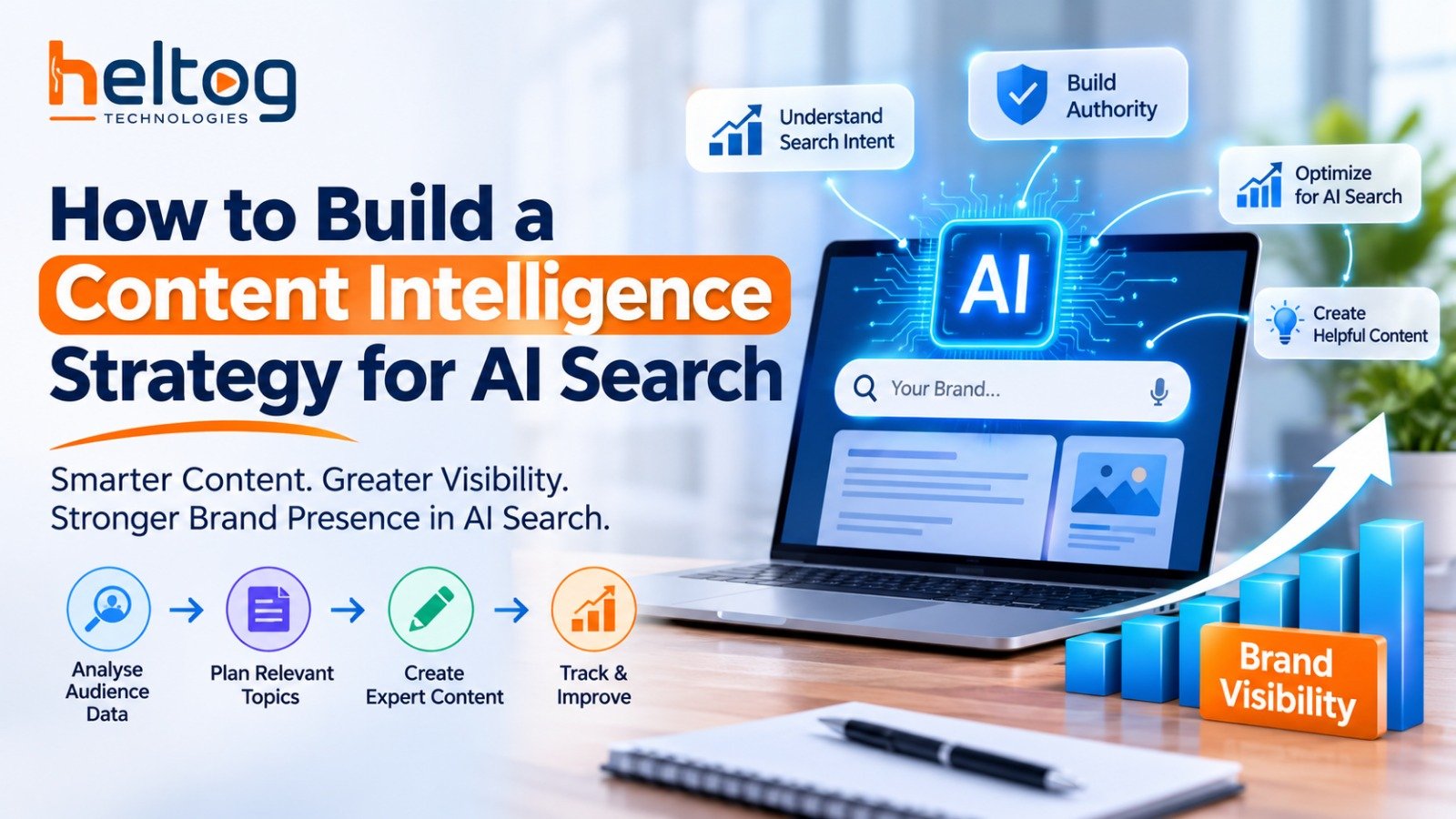
How to Build a Content Intelligence Strategy for AI Search
Developing an effective strategy requires more than using AI writing tools or publishing regular blog posts. Businesses need a systematic approach that connects audience research, content planning, optimisation, and performance measurement.
Step 1: Collect and Analyse Customer Data
Start by understanding your audience and identifying the information they need before making a decision.
Collect insights from different sources, including:
Google Search Console search queries.
Google Analytics website behaviour.
Customer reviews and feedback.
Sales and customer support conversations.
Social media comments and discussions.
Competitor content analysis.
Frequently asked customer questions.
Use these insights to identify common concerns, search patterns, and information gaps.
For example, if potential customers frequently ask how long SEO takes to deliver results, create a detailed article explaining SEO timelines, influencing factors, and realistic expectations.
This approach ensures that content is based on actual customer needs rather than assumptions.
Step 2: Map Search Intent and Topic Clusters
Once you understand your audience, organise relevant topics into meaningful groups.
Topic clustering helps businesses cover a subject comprehensively instead of publishing disconnected articles targeting individual keywords.
For example, a business focusing on digital marketing can develop the following content cluster:
Main Topic: Search Engine Optimisation
Supporting topics:
Technical SEO fundamentals.
On-page SEO techniques.
Local SEO strategies.
Keyword research and search intent.
Content optimisation.
Internal linking strategies.
AI search and Generative Engine Optimization.
Create a central pillar page and connect relevant supporting articles through contextual internal links.
This structure helps users explore related information and gives search engines clearer signals about the relationship between different pages.
Step 3: Create Helpful, Evidence-Based Content
Content quality should be the foundation of your AI search strategy.
Instead of publishing generic articles that repeat existing information, focus on providing original insights, practical examples, expert explanations, and reliable supporting evidence.
Every piece of content should address four important questions:
What problem is the reader trying to solve?
What information does the reader need?
What facts or evidence support the answer?
What should the reader do next?
Use clear language, meaningful headings, relevant examples, and actionable recommendations.
Where possible, include original research, case studies, expert opinions, and real business experiences. These elements help differentiate your content from generic AI-generated material.
Step 4: Make Content Easy for AI Systems to Understand
AI search platforms may retrieve individual sections of a webpage rather than relying entirely on the complete article.
Therefore, each important section should communicate its meaning clearly.
Follow these practices:
Use descriptive H1, H2, and H3 headings.
Answer important questions directly.
Explain technical terms in simple language.
Mention relevant brands, products, and services clearly.
Keep important conditions and qualifications close to the claims they explain.
Include essential information in crawlable text.
Use relevant internal links.
Implement appropriate structured data where applicable.
For example, instead of writing a vague heading such as "Why It Matters," use a descriptive heading such as "Why Is Technical SEO Important for AI Search Visibility?"
Clear structure improves readability and makes the information easier to interpret.
Step 5: Build a Consistent Brand Intelligence Layer
One of the most important parts of content intelligence is maintaining consistent and accurate brand information.
Your website, social media profiles, business listings, marketing campaigns, and other online platforms should communicate the same core business information.
Create a central repository containing:
Company introduction and background.
Products and service descriptions.
Target audience information.
Brand messaging and tone of voice.
Verified business facts.
Customer FAQs.
Case studies and supporting evidence.
Updated contact information.
This repository acts as a reliable reference for content teams and AI-assisted workflows.
Whenever a service changes or new information becomes available, update the relevant website pages and other important digital channels.
Step 6: Strengthen Internal Linking and Website Structure
Internal linking plays an important role in helping visitors and search engines discover related information.
A well-organised website connects relevant blog articles, service pages, and informational resources.
For example, an article about AI search optimisation can naturally link to:
SEO Services
Modern SEO in 2026: How AI Is Transforming Search
Technical SEO Fundamentals
Google AI Overviews and Branded Search
Use descriptive anchor text that explains what the linked page offers. Avoid adding links simply to increase their number. Every internal link should provide additional value to the reader.
Step 7: Monitor AI Search Visibility and Content Performance
Publishing content is only one part of the strategy. Businesses must regularly evaluate whether their content is reaching the right audience and supporting business objectives.
Traditional SEO metrics remain important, but AI search introduces additional areas to monitor.
Consider tracking:
Organic impressions and clicks.
Keyword rankings.
Website engagement.
Organic leads and conversions.
Branded search performance.
AI-generated brand mentions.
AI platform citations and references.
Accuracy of AI-generated brand information.
Content freshness and information gaps.
Create a fixed set of relevant customer queries and periodically check how different AI platforms represent your brand.
Track brand mentions, citations, and recommendations separately. A brand mention does not necessarily mean that an AI platform has cited or recommended the business.
Use these insights to identify opportunities for improving content quality, accuracy, and topical coverage.
Step 8: Regularly Update and Improve Existing Content
Content intelligence is an ongoing process, not a one-time activity.
Business information, customer expectations, search behaviour, and industry trends continue to evolve. Outdated content can create confusion and reduce the usefulness of your website.
Develop a regular content review process to:
Update outdated statistics and references.
Correct inaccurate business information.
Refresh service descriptions.
Add answers to newly emerging customer questions.
Fix broken internal links.
Improve incomplete or unclear sections.
Remove unnecessary repetition.
Review important claims and supporting sources.
Assign responsibility for reviewing important pages, particularly those containing pricing, service details, eligibility conditions, or other business-critical information.
Four Important Pillars of AI Search Content Intelligence
A useful way to evaluate your content strategy is to assess it through four interconnected areas.
1. Found – Discoverability
Can search engines and AI systems access and discover your website content?
Focus on crawlability, internal linking, accessible content, technical SEO, and logical website structure.
2. Scored – Relevance
Does your content answer the user's actual question?
Focus on search intent, topical coverage, content depth, and clear explanations.
3. Trusted – Credibility
Can readers and information systems verify the information you publish?
Focus on factual accuracy, original expertise, reliable sources, consistent business information, and regular updates.
4. Recommended – Suitability
Does your brand or service genuinely match the user's requirements?
Clearly communicate your services, expertise, differentiators, limitations, and supporting proof.
These four areas provide a practical framework for identifying weaknesses and prioritising improvements.
Common Mistakes to Avoid When Building an AI Search Content Strategy
Businesses often make mistakes when trying to improve their visibility across AI-powered search platforms.
Here are some common issues to avoid:
Publishing content without a clear purpose: Every article should address a genuine customer question or business objective.
Overusing AI-generated content: AI tools can support research and content production, but human expertise, fact-checking, and editorial review remain essential.
Ignoring traditional SEO: Technical SEO, helpful content, crawlability, and relevant internal linking continue to matter.
Using outdated information: Incorrect service descriptions, statistics, and company details can damage brand credibility.
Focusing only on keywords: Content should answer the complete search intent rather than repeatedly using the same keyword.
Ignoring performance measurement: Without monitoring visibility, engagement, and conversions, it becomes difficult to understand whether the strategy is delivering results.
How Businesses Can Prepare for the Future of AI Search
The future of digital discovery will involve a combination of traditional search engines, AI-generated answers, conversational interfaces, and other intelligent information platforms.
Businesses should start preparing by developing a strong digital foundation.
Focus on publishing original and helpful information, maintaining consistent brand identity, improving website structure, building topical authority, and monitoring how AI platforms represent your business.
Most importantly, remember that AI search optimisation is not about finding shortcuts to appear in generated answers. It is about making your business information accurate, accessible, relevant, and valuable.
A well-developed content intelligence strategy can help businesses create a sustainable approach to digital visibility while improving the experience they offer to potential customers.
Conclusion
Building a content intelligence strategy for AI search requires a combination of customer research, content planning, technical optimisation, brand consistency, and continuous performance analysis.
Businesses that understand customer intent, publish trustworthy information, connect related topics, and regularly update their content will be better prepared for the changing search environment.
Traditional SEO remains an important foundation, but brands should also consider how their information is discovered, interpreted, referenced, and presented by AI-powered platforms.
The real objective is not simply to publish more content or chase AI mentions. It is to build a reliable digital presence that helps customers find accurate answers and make confident decisions.
Frequently Asked Questions (FAQs)
1. What is a content intelligence strategy?
A content intelligence strategy is a data-driven approach to planning, creating, analysing, and improving content based on customer needs, search intent, business information, and performance insights.
2. How does content intelligence help with AI search?
It helps businesses create relevant, structured, and factually accurate information that is easier for search engines and AI systems to discover, interpret, and potentially reference.
3. Is traditional SEO still important for AI search?
Yes. Technical SEO, crawlability, helpful content, relevant internal linking, and website structure remain important foundations for search visibility.
4. What is the difference between SEO and GEO?
SEO focuses on improving a website's visibility in traditional search engine results. Generative Engine Optimization (GEO) focuses on improving the likelihood of a brand's content being understood, referenced, or mentioned in AI-generated search experiences.
5. How can businesses track AI search visibility?
Businesses can monitor a consistent set of relevant prompts across AI platforms, record brand mentions and citations, review the accuracy of generated information, and analyse available AI search reporting tools.
6. Does publishing more content guarantee AI visibility?
No. Publishing more content does not guarantee AI visibility. Content should be relevant, original, accurate, accessible, and useful to the intended audience.
7. How often should businesses update their content?
Important content should be reviewed regularly, with updates prioritised whenever business information, services, pricing, industry developments, or customer requirements change.
About Heltog Technologies
Heltog Technologies is a digital marketing and website development company helping businesses strengthen their online presence through result-oriented digital solutions. From SEO and Google Ads to social media marketing, website development, app development, and digital branding, Heltog provides services designed to support business growth.
With expertise across multiple digital channels, Heltog helps businesses build stronger online visibility, reach relevant audiences, and create meaningful digital experiences.
If you want to improve your website's search performance, strengthen your brand authority, and prepare your business for the evolving AI search landscape, connect with Heltog Technologies.
Build a smarter digital presence with Heltog Technologies.
Website: https://heltog.com/
Contact: +91 99997 34593
Found this article helpful? Share it!
H
Written by
Heltog Team
Digital marketing and technology expert at Heltog Technologies. Helping businesses grow with smart digital solutions.



Leave a Comment
Your email address will not be published. Required fields are marked *